A look at how a simple home tech project grew into a full homelab for self-hosting, application development, automation, and hands-on learning across infrastructure, security, and modern platform design.
What began as a practical home project quickly grew into something much bigger.
My original goal was straightforward: add storage to my home network, separate IoT devices, and create a more locked-down, privacy-focused environment for my growing boys. I wanted something safer, cleaner, and more scalable than a flat home network with a few devices and shared storage bolted on.
But that simple project turned into a full homelab.
Over time, it evolved into a personal home cloud: a platform for learning, experimentation, self-hosting, software development, and application deployment. It gave me a place to build things my own way, understand modern infrastructure from the inside out, and explore the same patterns used in enterprise environments. It has also been one of the most valuable hands-on learning investments of my career.
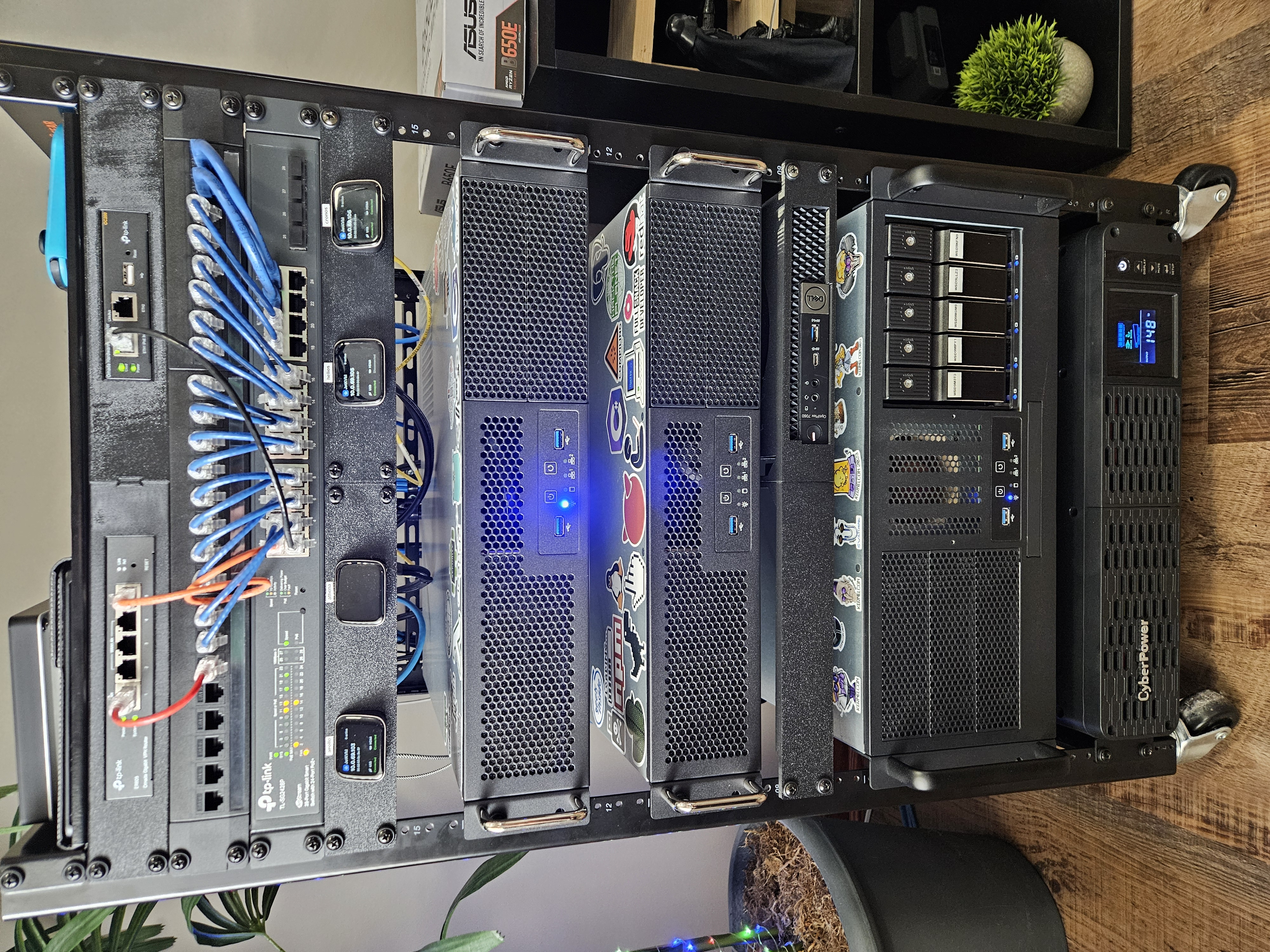
I have always enjoyed building things that are both useful and educational. A homelab sits right at the intersection of those two goals.
Practically, it helps me centralize storage, segment networks, improve privacy, stream media, host internal services, and run applications for my household in a more controlled way. Just as importantly, it gives me a safe place to experiment with technologies I want to understand more deeply.
That is what made the homelab stick.
Reading about virtualization, containers, software-defined networking, DNS, reverse proxies, monitoring, security tooling, or CI/CD is one thing. Designing, deploying, breaking, troubleshooting, and improving those systems yourself is something else entirely. That kind of repetition turns concepts into real understanding.
Today, the lab has grown into a multi-purpose platform that goes far beyond its original storage and network goals.
At a high level, it includes:
The list is interesting, but what matters more is what it represents: a layered system where compute, storage, networking, security, and application hosting come together in one environment I can keep improving.
One of the biggest turning points was adopting a more intentional virtualization platform.
Instead of thinking in terms of a few isolated machines, I started thinking in terms of infrastructure: clusters, workloads, services, recovery, segmentation, and lifecycle management. Proxmox became the backbone of that approach. It let me stand up virtual machines for different purposes, isolate workloads cleanly, and build an environment that felt more like a private cloud than a collection of home devices.
That flexibility changed everything.
Need a new Linux server for testing? Spin one up. Want to isolate a service into its own VM? Easy. Need to rebuild something from scratch without disrupting the rest of the environment? That becomes manageable. The ability to create, destroy, migrate, and redesign systems quickly makes experimentation far less intimidating.
It also pushed me to think more architecturally. Instead of making one-off changes and hoping for the best, I started thinking in terms of roles, boundaries, dependencies, and failure domains. NGINX-based ingress and reverse proxying reinforced that mindset by forcing me to think more carefully about how internal applications should be exposed and managed.
One of the most rewarding parts of building the homelab has been how much it deepened my understanding of Linux.
The lab gave me a reason to spend real time in the operating system rather than just touching it occasionally. By running Linux-based workloads every day, I learned far more about system administration, services, networking, permissions, package management, containers, logging, and automation than I ever could have from theory alone.
Along the way, I tried different distributions and approaches, partly out of curiosity and partly to understand the tradeoffs between them. Over time, I kept coming back to Debian. I appreciate its stability, simplicity, and the way it stays out of the way so I can focus on the systems and applications I am building on top of it.
That experience shaped more than my server-side skills. The more comfortable I became with Linux in the homelab, the more natural it felt to use outside the lab as well. Over time, that journey led me away from Windows as my daily driver and toward an environment that feels more aligned with how I like to work and build.
The networking side of the lab is where the project started to feel especially meaningful.
Network segmentation was one of the original goals, and it remains one of the most important. Modern households have a surprising number of devices with very different trust levels: laptops, phones, streaming boxes, smart home devices, media appliances, gaming systems, and tablets. Treating them all the same does not make much sense.
By creating separate network zones and applying more intentional controls, I was able to build better boundaries between device types and workloads. That improved both security and manageability while giving me a much deeper appreciation for how much good architecture depends on thoughtful network design.
Security became a natural extension of that work. As the lab expanded, I started incorporating monitoring and security tooling to improve visibility into what was happening across the environment. With tools like Wazuh, I have been able to explore logging, alerting, and endpoint visibility in a way that feels much closer to real operational practice than a typical home setup.
And of course, a homelab is never really finished. The more you learn, the more opportunities you see to tighten things up, reduce risk, simplify assumptions, and design for resilience.
Storage was the original catalyst, and it remains one of the most important parts of the environment.
As data accumulates, the need for centralized, reliable storage becomes obvious. Backups, media, shared files, application data, and long-lived content all need a home. That pushed me toward building a dedicated NAS layer with enough capacity to support both current needs and future growth, eventually centered around TrueNAS Scale.
That also became a lesson in architecture. Storage is not just about capacity. It is about reliability, layout, recoverability, performance tradeoffs, and operational discipline. It is about thinking ahead: how data should be organized, how it will be protected, and how services depend on it.
Once storage becomes a foundational platform instead of just extra disk space, you start making very different decisions.
At some point, running services in virtual machines naturally led to a bigger question: when should an application live in a VM, and when should it be containerized?
That is where Kubernetes entered the picture.
I started using Kubernetes to explore how modern distributed applications are deployed and managed. Running containerized workloads in a homelab is a great way to learn lessons that are difficult to absorb from documentation alone. Concepts like ingress, persistent volumes, service discovery, secrets management, scaling, and workload separation become much clearer when you are implementing them yourself.
I also built out a smaller Raspberry Pi-based cluster as a lightweight platform for experimentation. There is something especially satisfying about seeing distributed workloads run across tiny, inexpensive devices while still applying many of the same principles used in larger environments.
Just as importantly, the lab has given me a place to apply my software engineering background more directly. I use it to build and test applications, validate deployment patterns, and experiment with DevOps-style pipelines that move code from development into hosted environments. That makes the homelab more than infrastructure. It becomes a full platform for building, deploying, and operating software end to end.
For all the technical depth, one of the things I like most about the homelab is that it supports real household use cases.
It is not just a sandbox. It runs services that people in my home actually depend on.
That includes media streaming through Plex and Jellyfin, privacy-enhancing network services through Pi-hole, centralized storage, internal application hosting, and even a Minecraft server for my sons. Some services exist purely because I want to learn. Others are there because they are genuinely useful. The best ones are both.
That balance keeps the lab grounded. It would be easy for a homelab to become a pile of disconnected experiments. I have tried to build mine in a way that keeps it practical while still leaving room for curiosity and exploration.
The biggest value of the homelab is not any one technology. It is the way everything connects.
It has taught me how infrastructure decisions ripple into application behavior. It has taught me how networking, storage, compute, security, operating systems, and software delivery shape one another. It has taught me that reliability is usually the product of disciplined design rather than cleverness. And it has taught me to document, simplify, automate, and think in systems.
It has also made me better at troubleshooting.
When you run your own environment, you eventually encounter networking problems, failed updates, performance bottlenecks, storage constraints, access issues, DNS surprises, certificate problems, pipeline failures, and configuration drift. Working through those issues forces you to slow down, gather evidence, and reason carefully through systems. That kind of experience is hard to fake.
Most importantly, the homelab has helped bridge the gap between theory and practice. It gives me a place to apply what I learn and test ideas before they matter in more formal environments.
One of the most rewarding parts of this journey is how directly it translates into my day-to-day work.
The lab has helped me build stronger intuition around cloud-native architecture, distributed systems, automation, environment design, operational concerns, secure service deployment, and application delivery. Even when the exact technologies differ, the patterns carry over. Designing clear boundaries, thinking about resiliency, managing dependencies, and understanding operational realities are useful everywhere.
It has also made me more effective in conversations about modernization. When you have built and operated your own systems, used that same environment to develop and deploy applications, and spent time learning the operating systems underneath them, you bring a different perspective to architecture discussions. You think more concretely about tradeoffs, recognize where complexity hides, and understand that maintainability matters just as much as capability.
The homelab has become more than a hobby. It is part of how I continue learning as an architect, developer, and builder.
Like most good homelabs, this one is never really done.
There is always something to refine, rebuild, migrate, secure, automate, or document better. That ongoing evolution is part of the appeal. Each improvement teaches something new.
One area I am especially interested in exploring further is AI in the homelab: running my own local large language models, experimenting with private AI-assisted development workflows, and learning how these tools can fit into a self-hosted environment. I see a lot of potential there, not just for experimentation, but for practical development use cases as well.
I also want to keep pushing on platform engineering ideas, internal tooling, automation, and application deployment patterns that make the lab easier to manage and more capable over time.
What began as a simple effort to add storage and create safer network boundaries became a personal platform for growth.
My homelab has given me a deeper appreciation for infrastructure, a better understanding of modern application platforms, and a place to keep learning by building. It has helped me connect home technology, personal curiosity, software engineering, and professional development in a way that feels both practical and rewarding.
And maybe that is the best part of a homelab: it grows with you.
What starts as a few small improvements can eventually become a reflection of how you think, what you value, and what you want to learn next.